







In the 38 years that ayahuasca has been shared in Spain since the first session was held in 1987, there have been almost fifty legal cases either by importation or by entries and registration in therapeutic-spiritual retreats where ayahuasca was shared.
In all of them the cases were archived or acquitted. Many of them in courts of first instance and others in Provincial Courts in charge of three magistrates judges/judges such as those of Madrid, Barcelona or Malaga in which there were acquittals with very clear sentences such as the one of Malaga where
over 17 pages it is explained that «ayahuasca as such a plant preparation is not subject to international or national control, prohibition or control in Spain, as a psychotropic substance, drug or narcotic», or in other words, it cannot be included in the concept of «toxic drug, narcotic drug or psychotropic substance» referred to in Article 368 of the Spanish Penal Code.
The sentence ended with an anti-prohibitionist plea against ayahuasca by the court, after having heard the arguments of the lawyer Francisco Azorín and the scientific experts of ICEERS.
Carmen Castellanos, the judge, said that «a policy of greater tolerance accompanied by rigorous controls and regulation, avoiding absolute prohibitionism, could be more effective, or on the whole yield more benefits than harm».
Until now the provincial courts had been the highest judicial body in Spain in dealing with ayahuasca cases, being the Provincial Court of Madrid the last one to deal with one of them in which the accused person received an acquittal by this body but the prosecutor not happy with the result appealed to a higher court such as the High Court of Justice of Madrid formed by 5 judges. This body is only surpassed hierarchically by the Supreme Court and the Constitutional Court to which no case of ayahuasca has arrived yet. Well, according to my friend Francisco Azorín Ortega, lawyer in the case, who sent me the sentence today, the Superior Court of Justice of Madrid confirmed this July 10, 2025 the acquittal of the person accused of importing ayahuasca declaring in very precise paragraphs that ayahuasca is not illegal in Spain and also making clear with forcefulness in others the lack of sense of the prosecutor's appeal based on the available legal evidence and also marking a clear jurisdiction regarding the competences of the National Institute of Toxicology which is not responsible for ruling which substances are controlled and which are not, since the expert stated that ayahuasca was controlled, which the prosecutor seized on to try to challenge the acquittal through an appeal.
In Spain, which is not illegal despite containing natural DMT, since according to the INCB conventions only crystallized synthetic chemical DMT is illegal.
I share here some paragraphs of the sentence that are of great importance and value to definitively clarify the legality of ayahuasca:
«Without questioning the qualification of the National Institute of Toxicology, and the solvency of its reports, it is not its responsibility to establish which substances are controlled, legal consideration, since its competences as a technical body are those of assistance to the Administration of Justice and contribution to the unity of scientific criteria, to the quality of analytical expertise and the development of forensic sciences, by issuing reports and opinions, and practice of analysis and toxicological investigations entrusted, through research processes. «
«Because of its relation to what has been discussed, we must remember that ayahuasca or yagé is a decoction made by combining Banisteriopsis caapi and a second plant containing the DMT molecule - Psychotria viridis, Psychotria carthagenensis or Diplopterys cabrerana -. Although ayahuasca with such denomination is not a controlled substance in Spain, it contains DMT, an element included in the Convention on Psychotropic Substances made in Vienna on February 21, 1971, Annex I, and in RD 2829/1977, of October 6, which regulates psychotropic medicinal substances and preparations, as well as the control and inspection of their manufacture, distribution, prescription and dispensation. We must add that Banisteriopsis caapi, contained in the potion, was included in the annex of order 510/190/2004, of January 28, 2004, which established the list of plants whose sale to the public was prohibited or restricted due to their toxicity, an order that developed article 42 of Law 25/1990, of December 20, 1990, on Medicines, a regulation that was, however, annulled by judgment of the National High Court of June 27, 2005, which was later confirmed by the Supreme Court.
- Article 1 of the 1971 Convention establishes that “psychotropic substance” means any natural or synthetic substance or natural material in Schedule I, II, III or IV, and that “preparation” means any solution or mixture, in any physical state, containing one or more psychotropic substances in dosage form, and its article 3, on preparations and their control, states that, except as provided for in the provision, any preparation shall be subject to the same control measures as the psychotropic substance it contains and, if it contains more than one such substance, to the measures applicable to the substance that is the subject of the most stringent control. There is no doubt about the commitment made by Spain to apply international law in this matter; but its creator has provided a mechanism for qualified interpretation, both of the obligations assumed under the Convention and of the substances included in its schedules, through the annual reports of the International Narcotics Control Board, whose responsibility is to support and monitor compliance with the obligations assumed by the subscribers of the international control agreements. The Chamber of instance mentions two reports of the INCB - International Narcotics Control Board - a body established in the 1961 Single Convention on Narcotic Drugs, whose functions include the issuance of reports, their communication to the parties and publication, a body also mentioned in article 18 of the 1971 Convention, and the Chamber considers these opinions relevant for the interpretation and clarification of the treaty provisions. The 2010 Annual Report seems to conclude - vid. its paragraphs 284 and following - that no plants or plant materials or preparations thereof are controlled under the Convention or the 1988 Convention, and among the examples it cites “ayahuasca, a plant preparation originating from the Amazon basin, mainly Banisteriopsis caapi (a jungle vine) and another plant rich in tryptamine (Psychotria viridis) containing various psychoactive alkaloids such as DMT...” and in similar terms it pronounces itself in the same terms as the 1988 Convention.“ and in similar terms the 2012 report pronounces on plant materials not under international control that contain psychoactive substances, including ayahuasca, expressly indicating that preparations containing these ingredients are not under international control, and later insisting on the lack of clarity regarding the status of plants in terms of national or international control, invoking as an example that ”.... cathine and DMT are psychotropic substances included in Schedule I of the 1971 Convention, while the plants and preparations of plant origin containing them, namely khat and ayahuasca, respectively, are not subject to any restriction or control measures...".
- We share the criterion of the court of instance when it underlines the existing difficulty to accept that ayahuasca is included in article 368 of the Criminal Code, because although a systematic interpretation of the provisions of articles 1 and 3 of the 1971 Convention invites to conclude that this substance is subject to international control, as a “preparation”, for containing DMT, the International Narcotics Control Board in the aforementioned reports repeatedly denies it, this in addition to the also very qualified criterion of the Special Anti-Drug Prosecutor's Office, expressed in 2018 in a response to the Deputy Director of Operations of the Deputy Directorate of Customs Surveillance, which recognizes the lack of control of ayahuasca as a narcotic substance although it is a product that does contain a small concentration of substance included in the international schedules. It is interesting to remember that article 368 of the Penal Code is mostly considered as a blank penal norm, of necessary extra-penal integration, and that it does not have its own or autonomous concept of psychotropic substance, but the notion must be reached by means of extra-penal regulations, which makes it difficult to consider the conduct being prosecuted as incardinable in the penal type. Indeed, the order of the Supreme Court dated May 31, 2018 with invocation of previous doctrine of the Chamber states: “the jurisprudence of this Chamber has considered that the concept of drug or narcotic substance, whose trafficking and distribution and favoring its use proscribed by Article 368 of the Criminal Code, is determined by reference to what, in this regard, the International Conventions, signed by Spain and incorporated into its domestic law, and in this case, the Vienna Convention of 1971. Thus, the judgment of this Chamber number 713/2013, of September 24 , stated that «our legal system does not offer a criminal legal concept of drug and follows an enumerative criterion by reference to the International Conventions signed by Spain and published in the Official State Gazette - article 96 of the Constitution - using the system of lists or the determination by Ministerial Order of the Department of Health and Consumption that qualifies a specific substance as psychotropic or narcotic (STS 378/2006 of March 31). Therefore, the rule of Article 368 of the Criminal Code must be integrated by reference to those extrapenal provisions [...]». Likewise, with regard to the distinction between substances that cause serious damage to health and those that do not, the general guideline is to refer to what is determined in the international protocols in use, and thus indicates, in the judgment of this Chamber number 1486/1999, of June 29, as determining criteria: the degree of dependence it causes, its effects on the organism, the number of deaths caused and the degree of tolerance. It is, in short, a blank penal norm that completes its elements by reference to other types of norms, whether international, as in this case, or regulatory, and whose validity with the Constitution has been expressly recognized on numerous occasions”. Although other resolutions, e.g., STS of April 26, 2011 circumscribe the legislative technique applied to the recourse to a normative concept, a position that places us in an identical situation.»
WE DECIDE: dismissing the appeal filed by the Public Prosecutor's Office against the sentence dated November 18, 2024, issued by Section 4 of the Provincial Court of Madrid, in the abbreviated proceeding No. 434/2024, from which this case arises, we must confirm and confirm said decision, and we declare the costs of this appeal ex officio.
The judgment of the Superior Court of Justice:
Proceeding Criminal Matter 26/2025,
Appeal 24/2025
JUDGMENT Nº 316/2025
ILMA. MRS. PRESIDENT:
Mrs. MARÍA JOSÉ RODRÍGUEZ DUPLÁ
ILMOS. MRS. MAGISTRATES:
D. MATÍAS MADRIGAL MARTÍNEZ-PEREDA
Ms. MARÍA TERESA CHACÓN ALONSO
In Madrid, on the tenth day of July, two thousand and twenty-five.
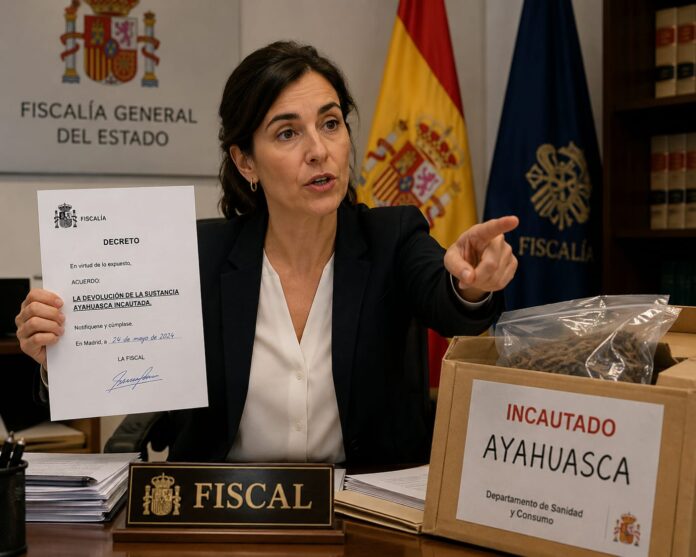
This sentence becomes the legal seal that confirms and clarifies the legality of ayahuasca in Spain making it clear that it is not considered a «drug» and that it is not legal to destroy it as confirmed by a recent sentence sent to me by the lawyer Oscar Palet Santandreu where the Provincial Court of Madrid ordered to return ayahuasca seized being the largest judicial body to do so today. I thank these two great lawyers and all the others who work on it and all those who responsibly share this medicine that helps to transform thousands of lives and to which science has already confirmed its infinite therapeutic potential for use in mental health.